Street stories from the Lion Mountains

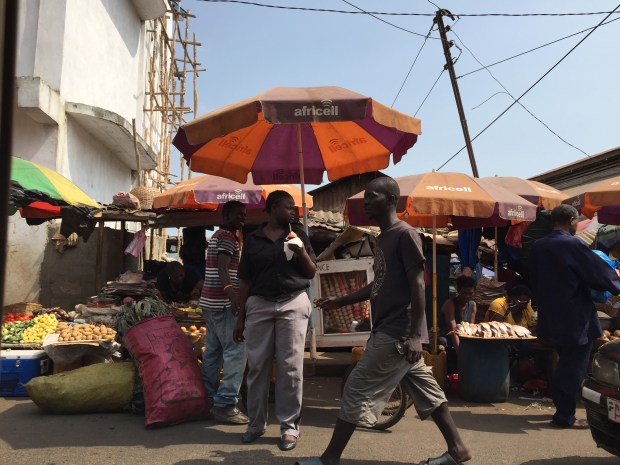
Life in Sierra Leone happens on the street, and you will never feel lonely outside. I love the buzzing, the chitchatting, the smells of smoke, fuel, food, sweat and perfume all mixed up, and the random pickup lines you hear (some of my recent favourites: “Today is International Women’s Day, I need an international date. Can I take you out?” or “I like you. You like me. Let’s go out.” or “Can I have your number? Don’t worry, I am diaspora Sierra Leonean, I will not bother you much.” or “You enjoy life too much, you need to start sharing that enjoyment. I am ready to enjoy with you, baby.”). I recently started collecting short movies of street scenes, as I think streets give you the best impression of life here in Salone – and there is so much great people watching to do! Here are some written stories.
2016-03-26 10.46.48.jpg

Life happens on the street – downtown Freetown

BIRTHDAY ON THE STREETS
As you might be aware, I enjoy celebrating birthdays (remember story email no 11…), preferably different every year. This time the theme was “on the STREETS” and we started with a sunset drink on the STREET at the beach, went on to have dinner in a Senegalese STREET restaurant, where the space was too small to fit us all, we shared chairs and I ended up standing half on the STREET to give my birthday speech. We then went on to the trade fair which was happening on the STREET around the national stadium. To enter, you buy a ticket, which is then again taken away from you two meters ahead, ripped apart and thrown on the ground. Why even bother printing those tickets, if their lifetime is about 1 minute before ending up on the STREET?! But you can imagine, it was fitting for my birthday theme ;).
IMG_1330.JPG

THANK YOU JESUS – for nice roads?!

KAPRY, KING OF THE STREETS
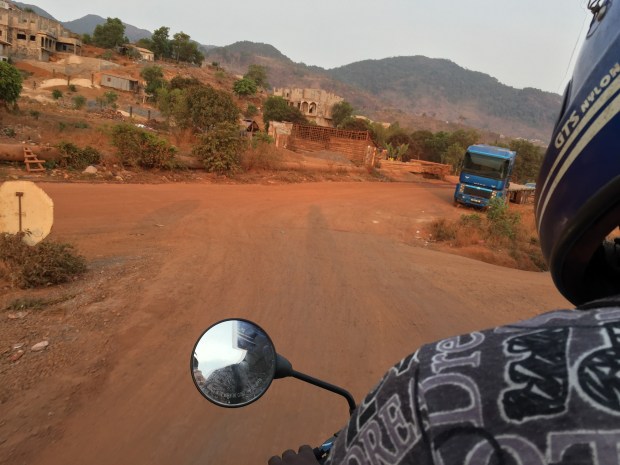
Since I still do not have my car back from my mechanic who had an accident with it (a different story that fills a whole email in itself), I keep using Okadas, motorbikes, imported from India, produced as cheaply as possible so that it is affordable in developing countries, but that also means that breaks fail regularly, gears sometimes get stuck and mirrors get lost all the time. Before my okada rider goes down a hill, I normally ask about their breaks quickly, just to be sure, because it has happened before that the breaks were actually broken. A very nerve-racking experience, going down hill with broken breaks.
My personal bike rider is called Kapry, he is the vice-chairman of the local okada bike rider association and he is very content with his life, which is a nice change to the usual “ah this is bad in my life and this is not working andandand”. He also is the man who never smiles, not even when I ask him to: “why should I smile, you don’t think I look fine without smiling?”. Kapry is THE one most punctual Sierra Leonean I have met, he would call me if I am 30 seconds late and he insists on doing phone-time-checks, making sure our phones show the same time, so that we both are on time for pickups. I have got a really bad reputation with him for being notoriously late, making me feel more African than he is.
On our last bike ride, he told me about his oldest brother, who went missing two weeks ago. He just left the house “quickly” and never came back, leaving his wife and two children in total agony about his whereabouts. Kapry has checked all police stations and hospitals in the area and spent yesterday at the mortuary, looking at dead bodies for hours. He shouts over to me all this information through his helmet and through my helmet, while speeding on through evening traffic, making us nearly hit a breadseller on the street, cruising on the pedestrian way around a big truck blocking the road, telling me about how his brother’s wife is having mental issues now and how he is ready to give up on his brother, just keep on living. Life is happening and being processed on the street, the good side of life and the bad one.
2016-03-19 18.31.41 HDR.jpg

Kapry on his okada – motorbike

And I know that the streets in your countries are much more likely to be rather empty, so you might enjoy this insight.

Ueberlebens-geschichten von den Loewen-Bergen

“ueberleben” hat eine ganz andere Bedeutung in einem Land, wo Leute taeglich und urploetzlich sterben, die Lebenserwartung halb so hoch ist wie in Europa und unbekannte Gefahren lauern in jeder Moskito, hinter jeder Strassenecke und in jedem Tropfen Hahnenwasser. “Ueberleben” hat auch ganz eine andere Bedeutung am Arbeitsplatz, wo es kein funktionierendes System gibt, man taeglich auf Eierschalen laeuft im Versuch die Interessen des Chefs, der Bevoelkerung und meine eigenen zu balancieren, wo es keine Elektrizitaet, ultralangsames Internet und keine Toilettenspuelung gibt, und wenn es regnet, dann ueberflutet dein Buero. Meine Schwester hat mir gesagt, sie hat den Eindruck dass mein Leben hier voller nie-endenden Dramen ist. Das stimmt, aber hat auch dazu gefuehrt, dass ich mittlerweile, nach zwei Jahren eine Ueberlebensexpertin bin. Ich arbeite nun am naechsten Schritt: nicht nur ueberleben, sondern auch aufzubluehen im mitten des Chaos!
Hier ein paar meiner unzaehligen Geschichten zum Ueberleben in Sierra Leone.

PISS PISS

Einer meiner ausgefallensten Freundinnen hier ist Theresa. Sie ist eine Sierra Leonerin in den Vierzigern und fuehrt ihren kleinen Laden direkt an der Hauptstrasse, in meiner Nachbarschaft. Ich gehen oft vorbei und sitze auf der Strasse, trinke ein lauwarmes Bier oder Wasser und diskutier mit ihr Gott, Liebe und die Welt. Eines warmen Samstagnachmittags, wir diskutieren gerade die Eifersucht von Sierra Leoner, als ich den Drang verspuehre, mich zu erleichtern. Ich frage Theresa nach der Toilette, worauf sie mich grinsend hinter den Laden fuehrt und jeden informiert, dass Naomi sich erleichtern muss (das haette mich wirklich warnen sollen). Hinter dem Laden sitzen zehn Frauen bei einer halb-offenen Tuere, die mich ebenfalls grinsend begruessen – eine weisse Frau die hier pissen muss, das ist eine kleine Sensation. Theresa zeigt zur halb-offenen Tuere und sagt mir, ich kann dahinter gehen. Hinter der Tuere ist absolut NICHTS – kein Dach, keine Toilette, kein fliessendes Wasser (geschweige denn Toilettenpapier), kein Loch, keine grafische Darstellung, die mir zeigen wuerde wie und wo ich pissen soll und auch kein Sichtschutz zur Hauptstrasse. Waehrenddem ich mich zu orientieren versuche, und jegliche Gedanken an vorherige Besucher dieser “Toilette” ausblende, Theresa kommt hinein und hockt neben mir. Wenigstens trage ich einen Rock, was es etwas einfacher macht und etwas Sichtschutz bietet und Theresa beginnt mir zu sagen, ich soll “pissen, pissen”, einfach nur “piss! Piss”. In ihrem Gesicht sehe ich sichtbaren Stolz, dass sie mit einer weissen Frau zusammen pisst –  wahrscheinlich das erste mal fuer sie (und auch das letzte mal…). Und ja, fragt erst gar nicht nach Haende waschen oder so! 😉

Die traurige Seite der Geschichte ist, dass die Mehrheit von Sierra Leone in aehnlichen sanitaeren Umstaenden lebt. Kein Wunder sind Krankheiten wie Durchfall, Cholera und Ebola allgegenwaertig.

SCHLAGANFALL PANIK

Eines Morgens schlief mir ploetzlich mein linker Arm ein. Es wurde etwas besser und dann wieder schlechter, aber ich dachte mir nicht viel dabei. Etwas spaeter ass ich zu Mittag mit einer Freundin, als mir auf einmal auch der rechte Arm, dann beide Fuesse und schlussendlich auch mein Gesicht, inklusive Lippen einschliefen. Ich bin ein grosser Fan von Dr Google und Selbstbehandlung (gerade in Sierra Leone aeussersts hilfreich, zumindest normalerweise) und google daher meine Symptome. Das erste Ergebnis, das auftaucht ist SCHLAGANFALL. Ich google weiter um herauszufinden, ob ich ueberhaupt einen Schlaganfall haben kann in meinem Alter – und natuerlich, es
gibt dutzende von Geschichten von Schlaganfaellen bei jungen Erwachsenen. Meine Freundin und ich sind mittlerweile nahe einer Panik und gehen sofort zum Arzt, der gluecklicherweise gerade auf der anderen Strassenseite ist. Beim Arzt beginne ich zu hyperventilieren und werde schliesslich ohnmaechtig. Der Doktor gibt mir eine Spritze
in meinen Hintern um mich wieder zu den Lebenden zu bringen und macht die notwendigen Tests. Nach einer Weile ist klar, ich habe “nur” Malaria – ich glaube, der Doktor hat noch nie jemanden so gluecklich gesehen mit einer Malaria Diagnose! Alles besser als einen Schlaganfall 😉

UM GNADE BITTEN

Ich war am Auto fahren und wollte einen Freund kurz absetzen. Verkehrsregeln existieren in Sierra Leone, aber werden eher auf einer zufaelligen Fall-zu-Fall basis umgesetzt. Ich dachte mir daher nicht viel dabei, als ich in einem Kreisel (es war ein grosser Kreisel, zu meiner Verteidigung) anhielt und meinen Freund rausspringen liess.
Dummerweise hielt ich DIREKT VOR einer Polizeistation. Der Polizist war mehr als gluecklich, mich wegen Verletzung von Verkehrsregeln fest zunehmen und zur Polizeistation zu begleiten um meine Aussage aufzunehmen. Es war so unglaublich heiss in der Polizeistation, dass ich kaum klar denken kann. Meine Aussage wird aufgenommen waehrenddem ich schweisstropfend auf der Holzbank sitze und von allen angestarrt werde. Ich bin immer noch am ueberlegen, wie ich am besten aus dieser Situation (und diesem heissen Raum) herauskomme, als ein Offizier kommt und mich fragt: “So, Madam, sollen wir Sie vors Gericht zitieren oder bitten Sie um Gnade?” Ich verstehe nicht ganz und er wiederholt: “Sollen wir Sie vors Gericht zitieren oder bitten Sie um Gnade?” Ich verstehe die Logik dahinter nicht ganz und finde, das ist nicht wirklich eine Wahl, aber sage schlussendlich, ich bitte um Gnade. Seine Antwort: “Gnade erteilt, ich wuensche Ihnen einen schoenen Tag, geehrte Frau!” Schnelles Urteil, unglaubliche Gnade! 🙂 ich gehe spaeter vorbei mit einem kleinen Ventilator als Dankeschoen und damit zukuenftige Verbrecher nicht so schwitzen muessen wie ich.

Survival-stories from the Lion Mountains

Dear readers,

“survival” has a whole other meaning in a country where people die randomly and all the time, life expectancy is half of what it is in Europe and there are unknown dangers waiting in every mosquito, behind every corner and in every drop of water. It also literally has a whole other meaning if you want to survive in your work place, where there is no functioning system, you are walking on eggshells everyday trying to juggle your bosses’ interests, your own and what you think the people’s interests are and there is no electricity, super slow internet, the toilet is not flushing and when it rains, your office gets flooded. My sister told me, she has the impression that the dramas in my life here are never-ending. However – living in this environment for two years now, I became an expert in surviving and I am now trying to reach the next level: thriving on top of surviving. Enjoy some of my countless survival stories!

PISS PISS

Theresa is one of my quirkiest friends here. She is a forty-something woman who runs her own small shop, right on the main road and close to my house. I often stop by and chat a bit, drink a lukewarm beer or cider and we chat about God, love and the world. One day and probably one too many drinks, I had to pee urgently and asked her to show me the bathroom. She started grinning (this should have been my first warning sign) and led me away from the shop, telling everyone “Naomi has to ease herself”. You can imagine how red my head turned. She leads me behind the shop somewhere with a half open door and about ten women sitting in front of the door, who obviously all were informed about the white woman who needs to pee. Theresa shuffles me through the door and tells me to piss there. I am lost – behind the door, there is NOTHING. No roof, no toilet, certainly no running water (not even thinking about toilet paper), no sign on where to pee, no hole and also no protection of sight from the main road. While I am trying to orientate myself and not too think too much about how many people might have eased themselves right where I was standing, Theresa comes and JOINS ME. So I am squatting there trying to avoid the main street (so thankful that I was wearing a skirt that day) with Theresa next to me who keeps telling me to “Piss piss”, “piss piss” and being obviously proud that she is pissing together with a white woman. Oh Salone. And yes, do not even ask me about hand washing facilities…

The sad thing about this story is that the sanitary situation of the majority of Sierra Leone is actually exactly like this: non-existent. No wonder diseases like diarrhoea, Cholera and Ebola are thriving.
STROKE PANIC

One morning, my left arm suddenly went numb. It got better and worse again, but I went about my normal business. I was having lunch with a friend when my right arm also got numb, then my feet fell asleep and finally my face and my lips – I didn’t feel the food anymore and had problems talking. Me being a fan of Dr Google and self- treatment, got into high panic when the first diagnosis that came up upon googling my
symptoms was STROKE. I went on to google if I could even have a stroke at my age and came across hundreds of stories of young people unexpectantly having suffered strokes. By that time both me and my friend were close to freaking out and went to see the Doctor, who luckily was just across the street. While they are taking my medical history (a must, especially in times of Ebola), I start hyperventilating and finally faint – all the drama. After an injection in the butt to get me going again and all the medical tests, the Doctor tells me I am having Malaria and he probably hasn’t seen anyone being so happy about having Malaria – at least it wasn’t a stroke!

PLEADING FOR MERCY

I was driving a friend’s car and dropping off someone. Traffic rules in Sierra Leone exist, but are implemented on a more case-by-case basis. I therefore didn’t think a lot, when I stopped in a roundabout (it was a big one, to my defence) and let my friend jump out. Stupidly enough, I did this RIGHT IN FRONT of a police station. The police officer was more than happy to charge me with violation of traffic rules, guide me to the station, let me park my car and have me go inside to give my statement. Inside the police station, it was SO incredibly hot, that I have problems thinking clearly. I give my statement while dropping with sweat and keep thinking about how to get out of this situation (and the hot room). At the end, an officer comes up to me and asks me: “So, Madame, shall we take you to court or do you plead for mercy?” I was confused and he repeated his question: “Shall we take you to court or do you plead for mercy?” I thought that is not really a choice, so said I would rather plead for mercy. His response “Mercy granted, have a nice day, mylady!” Quick justice, amazing grace!
I went back later with a small fan to say thanks and let them cool down the room for any other criminals.

When it is not possible to be ready to die

“People die here everyday, randomly and without good explanations.” I say this sentence in every longer conversation I have about Sierra Leone. It was always something very much matter of fact to me, just another statistic that I have saved in my head among the other key health indicators: maternal mortality 1165 per 100,000 live births, infant mortality 92 out of 1000, average life expectancy 48 years, GDP per capita 1500 USD per year, poverty rate 52%, 35% of pregnant women are teenagers, literacy rate among women 25%, ranking in the human development index: among the last 10 countries in this world. I am so used to these statistics, it doesn’t really move anything anymore in my mind, just some thoughts on how they were measured and if the right statistical approach was used. They are all screaming out that something is terribly wrong in Sierra Leone, that life years are wasted, families regularly hit with disaster and confronted with sickness and death.

I was never someone who was moved a lot by death. For me, the time of my and every one else’s death does not lay in our hands and is out of our control. I believe that we have a life after death and that death is just another milestone in this universal existence. In highschool, the best essay I wrote was titled “The aim of life is to be ready to die” and I lived according to it. The aim of life is to be ready to die. When it was someone’s time to reach that milestone, I normally thought that it was more or less justified and that life for us continues. Grandparents die after a long life, last stage cancer patients die after long treatment, only in rare cases are there exceptional deaths. My grandfather is receiving palliative care after few years of heavy medical interventions that kept him alive, including a bypass heart surgery ten years ago. His body has long been ready to die, but modern medicine wasn’t allowing this, giving his soul time to reach the point where he is ready to die. You do not get that time in Sierra Leone. There is no modern medicine, there is no working health system with heavy medical interventions and bypass heart surgery. You can be lucky if the clinic you are consulting with your pains has a qualified nurse who happens to be around and some painkillers in the shelf who are not expired or stocks just happened to have run out.

I was never someone who was moved a lot by death. I realised that people attend funerals regularly here in Sierra Leone, I realised that people tend to die younger than what I know from Switzerland. However, when one of the uncles of my closest friend died of Ebola or when the father of my night guard suddenly had to be rushed to hospital, dying of unknown causes and making my strong young guard crying out loud, I didn’t feel a lot. I didn’t feel a lot when the father of one of my best friends here died and avoided going to the funeral (it was Ebola times, after all, is what I told myself). I didn’t feel a lot when people kept commenting on the fact how lucky I was to still have both of my parents alive (why should they be dead, they are only in their fifties anyway?!). I just had my wake up call, literally. I woke up at 4am this morning to a text message from Kapry, saying that his sister in law has passed away. She was the wife of Lansana, whom I know well, the mother of an 18 month old girl who likes to dance to Nigerian music and she was my age. She was not ready to die and she shouldn’t have. Sierra Leone let her down and Sierra Leone also let the other 3500 women down who died during the last year in childbirth of preventable causes. Sierra Leone also let the 25,000 children down who die every year before they reach their 5th birthday. We let the 4000 people down who died because of Ebola, but a similar epidemic (even worse – as it is endemic) is happening in Sierra Leone in the front of all our eyes, written in all statistics. People are dying here all the time, randomly and without good explanations. And they are not given the time to be ready to die, they have not lived their life to the fullest of their possibilities, they have not had time to accept their fatal illness or had time to note down how they would like their funeral to happen. Sometimes, it is not possible to be ready to die – and it is up to us to change that, for everyone, especially in Sierra Leone.

I apologise for my ignorance so far. I apologise that it took me two years of living here to be shocked at a message of death. I apologise to all Sierra Leoneans and Africans for not giving you the time to be ready to die. Rest in peace, Madame Marie Kabbah, and thank you for waking me up from my ignorance. Let us hope and pray that your daughter will reach her 5th birthday and live way beyond that, enough long to be ready to follow you to where you are now.

Expanding | Mehr!

Thanks to a generous donation, the CIA school can expand their structures. Five different plans are discussed right now:

  1. School library
  2. Additional classrooms
  3. Staff room
  4. Home Economic center
  5. Concrete fence around the school to ensure security

Do you have an opinion on what would make sense? Let us know 🙂


Dank einer grosszuegigen Spende aus der Schweiz kann die CIA Schule expandieren. Verschiedene Projekte werden momentan diskutiert:

  1. Eine Bibliothek
  2. Mehr Schulzimmer
  3. Ein Lehrerzimmer
  4. Ein Hauswirtschaftszentrum
  5. Sicherheitszzaun um die Schule

Habt ihr Ideen oder eine Meinung dazu? Lasst mich wissen 🙂

Dark-stories from the Lion Mountains | Dunkle Geschichten von den Löwenbergen

“Dunkle-Geschichten von den Löwenbergen” – Geschichten-Email Nummer 14 von Freetown, Sierra Leone. Einfach kurz melden, falls du diese Geschichten lieber nicht mehr hören möchtest!
 

 “Dark-stories from the Lion Mountains” – story email number 14 from Freetown, Sierra Leone. Just drop me a line, if you’d rather not receive these emails anymore.

Meine lieben,
Mes chères,
My last two months of my time with the Ministry are ahead – happily enough not my last two months in Sierra Leone! Time for another story email.
Meine letzten zwei Monate als Angestellte der Regierung stehen vor mir – glücklicherweise bleibe ich noch etwas länger in Sierra Leone! Zeit für ein paar Geschichten.

BLACK COMPUTERS
Some of my darkest days I experienced at the Ministry. It is the days when you feel like everyone just wants to make money, GREED is like the general slogan of the Ministry and obviously it is these days that the internet is not working and there is no electricity. The last fact turned into a game for me: as soon as electricity goes, I set myself a time – if we do not have power by the end of that set time, I am allowed to go and treat myself to Frozen Yogurt in Gina’s, a lovely coffee place. Obviously, the main reason is to get electricity and internet again… 😉 Strategies to survive working in the Ministry!

SCHWARZE COMPUTER
Meine schlimmsten Tage habe ich normalerweise im Gesundheitsministerium. Es sind die Tage, wo ich das Gefühl habe, alles und jeder dreht sich nur ums Geld, GIER ist das Motto des Ministeriums und natürlich haben wir immer dann auch kein Internet und keinen Strom. Letzteres habe ich mittlerweile in ein Spiel entwickelt: sobald der Strom ausgeht, setze ich eine Deadline. Wenn bis dann der Strom noch nicht zurück ist, erlaub ich mir in ein nettes Café Eis essen gehen. So wird auch der Stromausfall zum Höhepunkt!

BLACK IN HEART
We were in the office the other day when I complained about Europeans and how they come in and think everything just works how it works in Europe. These consultants or visitors or Ebola-workers or whoever also think that I as a white work like a European, even though I work with all Africans in a completely African organisation (you can’t get more national then Government, I suppose). Anyway – I realised after a bit that I am complaining about myself in a way and the Western attitude of “we know it all a bit better than Africans” when I announced that I should probably stop ranting as I am one of those Westerners. My colleague said “no, no, you are one of us: you are black in heart. You are not a real white woman, you are more black.” Do hearts have colours?

SCHWARZES HERZ
Ich habe mich letzthin im Büro aufgeregt über Europäer, die als Kurzzeit Berater nach Sierra Leone kommen und denken, alles sollte so funktionieren wie in Europa. Diese Berater haben dann auch den Eindruck, ich als Europäerin bin ihre beste Bezugsperson und arbeite wie in Europa, jedoch vergessen sie dass ich in einem kompletten afrikanischen Umfeld und System arbeite. Man kann wahrscheinlich nicht sierra leonischer sein als die Regierung! Die Erwartungen klaffen also oft auseinander und die Haltung “Wir wissen es einfach etwas besser als die Afrikaner” nervt mich teilweise. Wie auch immer – nachdem ich mich beschwere bei meinen Teamkollegen, realisiere ich auf einmal dass ich ja auch so eine Europäerin bin. Meine Teamkollegen meinen darauf: “Nein, Naomi, du bist eine von uns, du bist keine richtige Weisse. Dein Herz ist schwarz.” Hat ein Herz eine Farbe?

DARK WHISTLERS
I like whistling. And I do it a lot, also when I am not aware of it. Back in Europe, nobody would ever comment on it. Here, I was surprised to get comments regularly like “oh, so you like whistling?” or “oh Naomi, you know how to whistle!” etc. I was slightly surprised, but didn’t think more. One day, a Sierra Leonean told me about devils and what they believe about them. He said, that there is a devil called “Rouffi” who comes around your house whistling – hence why nobody should be whistling, or they think you are a devil. Wow, what a revelation! Whistling made me a devil here.

DÜSTERE MUSIK
Ich pfeife gerne und oft. Teilweise auch, wenn ich es nicht einmal selbst bemerke. Das wäre nichts auffälliges in Europa – hier jedoch bemerkt das jeder und jede und fragt mich, ob ich gerne pfeiffe oder kommentiert meine Pfeiff-fähigkeiten (die nicht übel sind ;)). Ich war etwas überascht, als ich erfuhr, dass es ein Teufel hier gibt, den man Rouffi nennt. Rouffi kommt zu dir mit einem Pfeiffen – darum sollte/darf niemand pfeiffen. Die denken, ich bin ein Teufel!

DARK COMMENTS
What are the worst comments a woman can get in our culture? Whenever I get back from holidays, I normally get a bright smiling “Welcome back, Naomi! You are FAT! You look beautiful!” straight in my face. The “you look FAT” part of that statement normally gets stuck more and is the best motivation to keep my rigorous “after-holiday” diet. This however was not appreciated by my colleagues who started force-feeding me after telling me: “you are on a diet? But why? You have nothing to lose!” They realised after a while that I kept giving all the food they brought me to our office runners and security guards. Their newest statement is that “Naomi is a very poor eater”. If they would have any idea of how much ice cream I can eat…
 

UNERWÜNSCHTE KOMPLIMENTE
Was ist der schlimmste Kommentar, den eine Frau erhalten kann? Immer wenn ich von Reisen zurück komme, erhalte ich ein lachendes “Willkommen zurück, Naomi! Du bist DICK! Du siehst wunderschön aus!”. Den “du bist dick” teil des Kommentars bleibt mir normalerweise besser in Erinnerung und ist die beste Motivation für eine strikte nach-Ferien-Diät! 😉
Das wiederum wird von meinen Arbeitskollegen nicht gerne gesehen. Die zwangsfüttern mich dann mit dem Kommentar “Du bist auf Diät? Aber wieso? Du hast nichts an dir abzunehmen…” Ich hab mich dann ein paar Mal erfolgreich gegen die Zwangsfütterung gewehrt und der neuste Kommentar ist nun “Naomi ist eine sehr schwache Esserin”. Wenn die nur wüssten, wie viel Glace ich essen kann…

WINTER DAYS
You see: not all dark stories are dark in Sierra Leone. No wonder, the sun is shining way too often for things to be dark. Even though they get darker now: rainy season is here! Which for me means, I am not swimming in the sea or the pool anymore and I walk around in a sweater – with outside temperatures of “mild” 28 degrees Celsius and down to 25 (!) degrees at night! It is way too cold and I keep telling people it is winter. I think my body finally started adapting to the climate here…

WINTERTAGE
Ihr seht: nicht alle dunklen Geschichten sind wirklich so dunkel in Sierra Leone. Kein Wunder, die Sonne scheint viel zu oft! Auch wenn momentan die Tage etwas dunkler werden: die Regenzeit erreicht bald ihren Höhepunkt. Das bedeutet, dass ich nicht mehr schwimmen gehe und einen Pullover trage – Temperaturen sind tagsüber um die 28 Grad tief und nachts bis zu 25 Grad! Es ist viel zu kalt und alle stimmen mit mir überein, wenn ich sage “es ist Winter”. Ich glaube, mein Körper hat sich langsam an Sierra Leone gewöhnt… Regentage

Ich wünsche euch einen wunderschönen Sommer und viele schöne dunkle Geschichten,
I wish you a lovely summer and many happy dark stories,
Noemi

Construction in progress | Schule bauen!

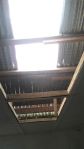
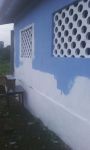
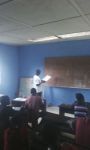
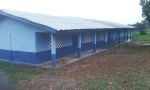
The CIA school in Kenema has been busy fixing the roof and remaining two classrooms, as well as the latrine. It also gave the whole building a lovely blue coat! Look at the pictures for some impressions.
The teachers received part of their salaries (they shared the money we sent to them) and are super happy – they say THANKS!


Die CIA Schule in Kenema war die letzten Wochen sehr beschäftigt mit der Fertigstellung des Daches, der letzten zwei Klassenzimmer und der Latrine. Sie haben die ganze Schule wunderschön blau angemalt! Schaut euch die Bilder an für mehr Eindrücke.
Die Lehrer haben teil ihres Lohnes erhalten (sie haben das Geld unter sich geteilt) und sind überglücklich – sie sagen DANKE SCHÖN!!!

(Un)happy birthday, Ebola! How a financing scheme can restore the health system of Sierra Leone

A year after the declaration of Ebola in Sierra Leone, we are looking back and reflect on our lessons learnt, while fighting the last few remaining cases. It is simple to explain why Ebola could get out of control so easily in Sierra Leone. The reasons range from underfinanced health system, lack of medical education, not having enough staff to weak governance and coordination. We recognised that Ebola was spread and fought in communities. Being plain honest: I have been thinking a lot that we probably wouldn’t have ended up in such a chaos if more money would have flown directly to health facilities and therefore communities. They could have protected themselves as much as possible and would have had incentives keep providing essential health services, while feeling protected. There is an example of a Maternal and Child Health Post in Gbongboma who constructed a holding center out of palm trees, to the best of their abilities. Initiatives like these finally allowed the spread of Ebola to slow down – interventions at community level. They need to be at the heart of any recovery strategy.

As part of the post-Ebola recovery plan, Sierra Leone is implementing a performance financing scheme. The Performance Based Financing (PBF) scheme is paying incentives to health workers and investments for health facilities based on its number and quality of services provided. It is more than “just” financing: it is a systems approach, improving quality and quantity of services through regular supervision and agreed targets. Service provision, verification, supervision and payment function are clearly separated, hence increasing accountability. The reputation of Sierra Leone’s Ministry of Health and Sanitation has been questionable before Ebola and the unaccounted one third of Ebola funds as highlighted in a recent audit report did the rest. Donors are not trusting the Ministry, which meant that a large part of the Ebola fight was outsourced to more reliable partners. The Performance Based Financing scheme is an opportunity to restore trust in the supervising Ministry as well as providing much needed funds for essential health services. A results-based approach means that monthly updates will be provided on the indicators covering a comprehensive package of health services, only paying for actual services delivered. The performance framework guarantees that health workers who work harder and better, also earn more.

Maybe the most important aspect of the scheme is its strong voice for patients and communities: patient satisfaction surveys are essential part of the scheme and will influence the incentive payments. This is a much needed addition in the Sierra Leone health sector, where it generally is a challenge to get patients adequately represented and listened too – even though they are the main stakeholders in the health sector. Community committees are part of the designing of business plans of health facilities. Let them decide, what they need and want from their health service provider. This way, they can prepare themselves for other epidemics and do not need to wait on the central level Ministry to intervene.

The PBF is restoring trust of patients in the health system through increasing its quality and social marketing strategies. It also motivates and equips health staff again to do their work, while leaving them the autonomy to manage their own facility. Cash injections into the community through the health facilities increase local ownership and also have economic multiplier effect: the local carpenter can pay the school fees of his daughter with the profit he makes from fixing a delivery bed, for example.

The total funding needed for the next five years of recovery in Sierra Leone is up to 1 Billion US-Dollars. Spending money through a results-based approach like PBF is four times as efficient as traditional input financing, which means that any dollar raised to help Sierra Leone recover from Ebola is best spent through PBF, making it equivalent to four dollars otherwise spent. In a pilot PBF scheme running now, 1.2 Million US-Dollars are sent over six months directly to 110 health facilities. Small money relating to the overall recovery strategy, big money for the receiving facilities. Bringing market approaches to the health sector doesn’t make it evil: it is a necessary move to make it work more efficient, effective and transparent. All attributes are much needed in the Sierra Leone context.

PBF Verification in Makeni

PBF Verification in Makeni

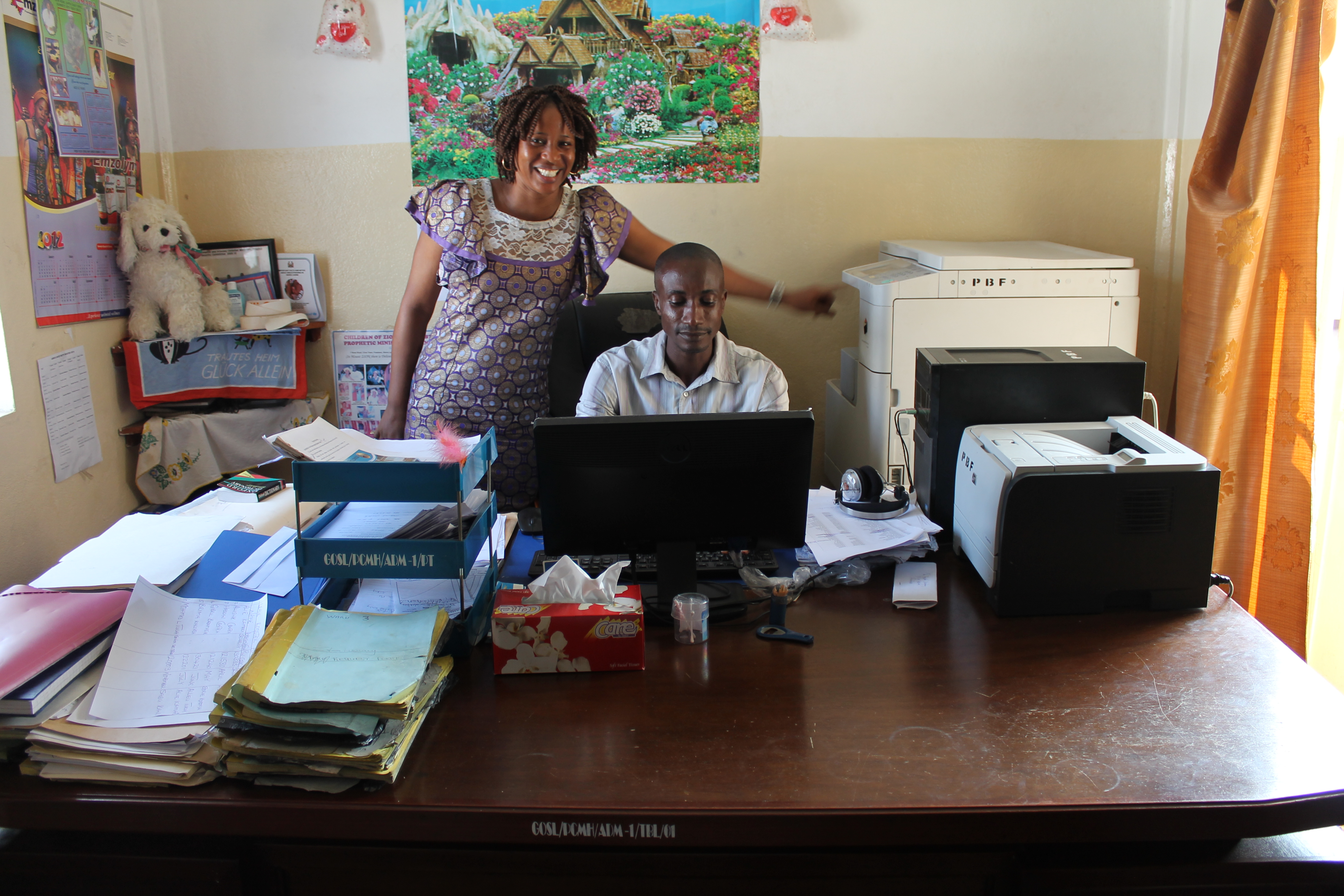
The hospital secretary and the financial officer of Princess Christian Maternity Hospital in Freetown

The hospital secretary and the financial officer of Princess Christian Maternity Hospital in Freetown