An update on Performance Based Financing of health facilities in Sierra Leone

  • Overview of Performance Based Financing


Performance Based Financing (PBF) was introduced in all 1200 public health clinics and selected private clinics in 2011. It is funded through the Reproductive and Child Health Project from the Worldbank and has so far sent about 15 Million US Dollars directly to facilities, who have invested 40% of that money in upgrading and maintaining the facility and the remaining 60% as incentive for staff performance. The project was externally verified through Cordaid in 2013/2014, who found increased motivation of staff and that small investments were being done, but also large disparities in data collected, weak financial management structures and generally low knowledge and capacity in the scheme.

With support of Cordaid, the Ministry has now developed a plan to move towards PBF PLUS as a first step to strengthen the health system in the Ebola recovery phase. PBF PLUS is addressing the weaknesses of the existing scheme and aims to increase transparency and governance, as well as ownership of the Ministry in the health sector. It addresses some of the key issues of the ministry such as low quality of services, under-financing of the health sector, weak coordination and decentralization and low transparency.


  • PBF light

The current scheme is called PBF light, as its design is not fully reflecting PBF standards. It resembles more a payment scheme with some pay-for-services elements. It has been administrated from national level, with verifications being done by the DHMTs. The scheme will be upgraded slightly in 2015 to prepare the health system for the move towards the PBF PLUS.

The PBF light scheme is an integral part of service deliveries at PHU level. Health workers motivation is highly linked to PBF payments and the direct cash flow has allowed basic maintenance and investments. The World Bank has been funding the PBF scheme through the Reproductive Child Health Project 2, which runs until October 2016. From the beginning, the idea has been that Government buys into the PBF scheme and starts contributing to service delivery at primary level using the PBF. However, the World Bank remains the only funding source and the scheme is now running out of money. RCHP2 allocation is enough to pay incentives up until the end of March 2015, which means that facilities will receive money up until about October 2015, as payments are done after delivery of services. There is an urgent need to raise 2.1 million US Dollars to keep paying the facilities or find another solution for the future of the PBF light.


  • PBF PLUS

The PBF PLUS scheme is implementing a full PBF structure with clear separation of functions, higher autonomy of the facilities while having regular supervision, a comprehensive indicator list and feasible prices being paid for services and quality at facilities. The payment structure is going to be simplified in order to decrease payment delays. Clear separation of functions (Verification, service delivery and payment) leads to greater governance and transparency. The Ministry can easily take ownership of the indicator list and quality checklist and guide the health service delivery in the direction it wants. At the same time, results are clearly visible and can be tracked.

The PBF PLUS will be piloted in Bombali in the second half of 2015 before being evaluated and rolled out nationwide. The idea is that Government is flowing part of their budget for health through the PBF and strengthen primary and secondary care services through a clear performance approach, where facilities who perform better also receive more money. The total funding needed is 24 Million US Dollars, where among other donors the World Bank is willing to contribute, if the Government buys in as well.

Teachers | Lehrer Ruth Vines Memorial School

A monthly salary of a primary school teacher is 100 US Dollars (500,000 Leones, 70 GBP, 100 CHF). These are the teachers looking for sponsors, choose your own and let Noemi know (send an email to noemi.schramm@gmail.com or comment on this post):
1) Salamatu Tommy – Diploma in Air Aviation Management; Computer skills training – Nursery 2
2) Joseph Mustapha – No higher education –  Class 2
3) Millicent Kamara – Teachers Certificate and doing HTC now –  Head Teacher, Class 4
4) Haja Tommy – Diploma in Business Administration – Nursery 1
5) Charles Kamara – Doing Teachers Certificate training 2nd Year- Class 3
6) Beatrice Kamara – Doing Teachers Certificate training 1st Year – Nursery 3
7) Unisatu Koroma – Teachers Certificate – Class 1

Untestehend siehst du, welche Lehrer noch Unterstützung brauchen. Ein monatlicher Lohn ist 100 US Dollars (500,000 Leones, 70 GBP, 100 CHF). Such dir jemanden aus und kommentiere das entweder auf diesem Beitrag oder sende ein Email an noemi.schramm@gmail.com. Merci beaucoup!
1) Salamatu Tommy – Diploma in Air Aviation Management; Computer skills training – 2. Kindergarten
2) Joseph Mustapha – keine höhere Ausbildung – 2. Klasse
3) Millicent Kamara – Lehrer Ausbildung – Hauptlehrer, 4. Klasse
4) Haja Tommy – Diploma in Business Administration – 1. Kindergarten
5) Charles Kamara – In der Lehrerausbildung – 3. Klasse
6) Beatrice Kamara – In der Lehrerausbildung – 3. Klasse
7) Unisatu Koroma – Lehrer Ausbildung – 1. Klasse

(Un)happy birthday, Ebola! How a financing scheme can restore the health system of Sierra Leone

A year after the declaration of Ebola in Sierra Leone, we are looking back and reflect on our lessons learnt, while fighting the last few remaining cases. It is simple to explain why Ebola could get out of control so easily in Sierra Leone. The reasons range from underfinanced health system, lack of medical education, not having enough staff to weak governance and coordination. We recognised that Ebola was spread and fought in communities. Being plain honest: I have been thinking a lot that we probably wouldn’t have ended up in such a chaos if more money would have flown directly to health facilities and therefore communities. They could have protected themselves as much as possible and would have had incentives keep providing essential health services, while feeling protected. There is an example of a Maternal and Child Health Post in Gbongboma who constructed a holding center out of palm trees, to the best of their abilities. Initiatives like these finally allowed the spread of Ebola to slow down – interventions at community level. They need to be at the heart of any recovery strategy.

As part of the post-Ebola recovery plan, Sierra Leone is implementing a performance financing scheme. The Performance Based Financing (PBF) scheme is paying incentives to health workers and investments for health facilities based on its number and quality of services provided. It is more than “just” financing: it is a systems approach, improving quality and quantity of services through regular supervision and agreed targets. Service provision, verification, supervision and payment function are clearly separated, hence increasing accountability. The reputation of Sierra Leone’s Ministry of Health and Sanitation has been questionable before Ebola and the unaccounted one third of Ebola funds as highlighted in a recent audit report did the rest. Donors are not trusting the Ministry, which meant that a large part of the Ebola fight was outsourced to more reliable partners. The Performance Based Financing scheme is an opportunity to restore trust in the supervising Ministry as well as providing much needed funds for essential health services. A results-based approach means that monthly updates will be provided on the indicators covering a comprehensive package of health services, only paying for actual services delivered. The performance framework guarantees that health workers who work harder and better, also earn more.

Maybe the most important aspect of the scheme is its strong voice for patients and communities: patient satisfaction surveys are essential part of the scheme and will influence the incentive payments. This is a much needed addition in the Sierra Leone health sector, where it generally is a challenge to get patients adequately represented and listened too – even though they are the main stakeholders in the health sector. Community committees are part of the designing of business plans of health facilities. Let them decide, what they need and want from their health service provider. This way, they can prepare themselves for other epidemics and do not need to wait on the central level Ministry to intervene.

The PBF is restoring trust of patients in the health system through increasing its quality and social marketing strategies. It also motivates and equips health staff again to do their work, while leaving them the autonomy to manage their own facility. Cash injections into the community through the health facilities increase local ownership and also have economic multiplier effect: the local carpenter can pay the school fees of his daughter with the profit he makes from fixing a delivery bed, for example.

The total funding needed for the next five years of recovery in Sierra Leone is up to 1 Billion US-Dollars. Spending money through a results-based approach like PBF is four times as efficient as traditional input financing, which means that any dollar raised to help Sierra Leone recover from Ebola is best spent through PBF, making it equivalent to four dollars otherwise spent. In a pilot PBF scheme running now, 1.2 Million US-Dollars are sent over six months directly to 110 health facilities. Small money relating to the overall recovery strategy, big money for the receiving facilities. Bringing market approaches to the health sector doesn’t make it evil: it is a necessary move to make it work more efficient, effective and transparent. All attributes are much needed in the Sierra Leone context.

PBF Verification in Makeni

PBF Verification in Makeni

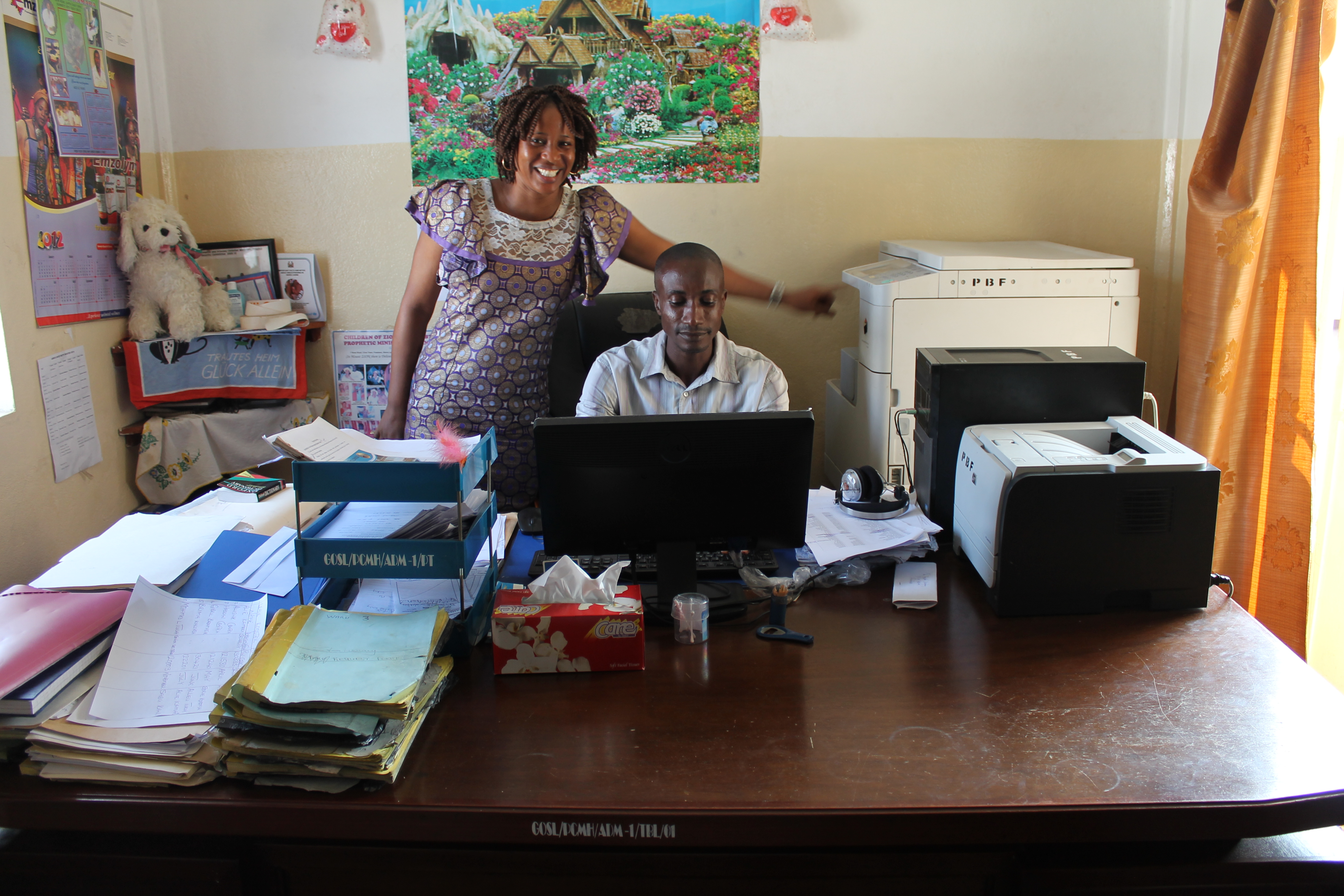
The hospital secretary and the financial officer of Princess Christian Maternity Hospital in Freetown

The hospital secretary and the financial officer of Princess Christian Maternity Hospital in Freetown

The 10 commandments of health financing following the results of the National Health Accounts 2013

The results of the 2013 National Health Accounts are drawing a picture of funds in the Health Sector in Sierra Leone: where do they come from, how do they flow to which provider and end user. 10 commandments can be drawn from that survey as recommendations for the health sector.

SUMMARY OF RESULTS OF NATIONAL HEALTH ACCOUNTS 2013

The government of Sierra Leone allocated 11.2% of the national budget to Health in 2013, the highest percentage in the 6-year period beginning in 2008 and an increase from only 8.5% in 2012.[1] Total health expenditure (THE) in Sierra Leone in 2013 amounted to Le 2.5 trillion, or the equivalent of approximately USD $590 million. Of this amount, the government contributed 6.8% of those funds. Donors contributed 24.4% of this spending, and NGOs 7.2%. Out of pocket (OOP) expenditures by utilizers of the health system (households) made up the vast majority of spending, at 61.6%. THE per capita in 2013 was USD $95.10, with donors contributing USD $23.20, GoSL and NGOs $6.50 and $6.80 respectively, and OOP again contributing the greatest share at $58.60 per capita. Out of pocket health expenditures are a heavy burden on household finances, and catastrophic unanticipated health care expenses are a driver of continuing poverty for households in the country.

The greatest amount of expenditures in 2013 went into public hospitals, follow by PHUs (37% and 28% respectively) – combined, the two levels of public health service delivery capture over two thirds (65%) of total health expenditures. Private health facilities captured 9%, pharmacies 4%, and only 3% supported administration / government health administration agencies. This reflects the reality that the majority of health care is provided by the public sector. 85% of all expenditures went into care seeking – 65% going to outpatient curative care and 20% to inpatient services. 10% went to information, education, counseling, and other preventive care programs, with only 2% supporting administration.

While government and NGOs spent around 40% of their contributions on children under 5, Donors spent over half (60%). In contrast, only 20% of OOP expenditures went to under-5s. This reflects the implementation of the Free Health Care Initiative, which is supported largely by donors and is intended to reduce the burden of health care costs for women and children on households. This picture indicates that FHCI is reaching its goals in reducing household expenditure on health care for the target groups, and releasing funds for treatment of older children and adults. However, the high overall OOP expenditures also indicate that households are still struggling despite the reduced burden, and the majority of Sierra Leoneans are not covered under FHCI.[2]

RECOMMENDATIONS FOR HEALTH SECTOR IN SIERRA LEONE

Key recommendations for senior decision-makers are:

1) The high Out-Of-Pocket expenditures show the need for further reductions of user fees, which is also in line with government strategy as stated in pillar 3 of the Agenda for Prosperity.

2) Government expenditures on health as percentage of total government expenditures need to be increased from currently 11% to 15% in order to comply with the Abuja target.

3) In 2013, GoSL was contributing less than Donors and NGOs to total health expenditures. In order to increase sustainability, Government is advised to take ownership and increase their contribution to the health sector.

4) In order to increase cost-effectiveness, it is advisable to spend more on primary care than secondary and tertiary care. Currently, 60% of funds are flowing into hospitals, while 40% are spent on primary care clinics.

5) Every tenth Leone is spent in a private facility. Government is encouraged to invest in public-private partnerships to yield some of the benefits of the private sector while satisfying demand of people.

6) In 2013, epidemiological surveillance and disaster and emergency preparedness were hardly financed, which explains the weaknesses encountered during the fight against the Ebola virus. In order to mitigate that risk in the future, financial investment in that area is needed.

7) Only 3662 Leones (approx 60 cents) per capita were spent on capital investments, such as infrastructures, buildings or similar. Capital investments are the foundations for stronger and more robust health systems for future generations and should be invested more.

8) Both NGOs and Donor organisations are contributing significantly to the Free Health Care Initiative. Maintain the good relationship between NGOs, Donors and GoSL for the continued implementation of the Free Health Care Initiative.

9) National Health Accounts are an annual event to inform Government and key stakeholders about the state of the health sector from a financial perspective. Government can draw part of the Health Financing Strategy and Policy out of this document and should ensure the regular occurrence of the NHA.

10) A large proportion of Government expenditures on health are spent on staff, however, there is still a shortage of health workers, especially in the higher cadres. Government is to invest additional funds into training of health care workers and develop retention strategies both to keep workers in country and at their work station. Make sure to not pay workers who are not showing up at their work station and provide incentives for hard working and well-performing staff (e.g. through Performance Based Financing).

[1] Preliminary expenditure report, Budget 2009-2014, MoFED

[2] MoHS, Sierra Leone National Health Accounts 2013

Some Q&A at the height of the Ebola outbreak in Sierra Leone

Interview of Maria Bertone held in November 2014 with the Directorate of Policy, Planning and Information of the Ministry of Health and Sanitation in Freetown

  1. Introduction

Noemi Schramm, Acting Unit Head & Health Economist, Health Financing Unit, DPPI, MoHS, GoSL

https://www.linkedin.com/profile/view?id=112471512&trk=nav_responsive_tab_profile

  1. Interview questions

From our offices in Europe, reading daily Ebola updates and news, we tend to imagine that nowadays a city like Freetown, the capital of one of the countries most affected by the outbreak, Sierra Leone, would look like as a barren, empty, post-apocalyptic town. Perhaps our perceptions shaped by the footage of the “lockdown” (http://vimeo.com/106806835) – when a three-day curfew was imposed on the entire country of Sierra Leone to allow volunteer to go house by house to sensitize the population and track down suspect Ebola cases (LINK). For those who know Freetown and West Africa in general, it was shocking to see empty roads and such eerie quietness.

How does the city look like today? What is the dominant atmosphere? Is everything close down or are shops and markets open and people fill the streets as usual and report regularly to work?

Life is going on as normal – with some small limitations. People are not shaking hands anymore, taxis and poda-podas (mini buses used for public transport) are less crowded and clubs are closed at night. However, people are still selling, buying, going to work, organizing their lifes, visiting family and friends and catching up with the latest football news. As most of the small cinemas showing football games are closed now, people with TVs in their house have become popular! Churches and Friday prayers are still allowed to happen and people spend significant times following religious services. As schools are closed, there are more children on the street either playing or selling things. So yes: life is bustling as normal during the day, but probably a bit quieter in the evenings. However, this obviously also depends on what community you live in. There have been isolated disturbing scenes in the East of Freetown, but the city never collapsed as much as Monrovia did. There were no public riots, no panicking public. Sierra leoneans are very resilient.

What are the main challenges for people’s daily life in Freetown?

Paying for food. Food prices have gone up and combined with less jobs or less secure jobs available, providing for the daily needs is even more of a challenge now. Furthermore, the situation in some rural parts of Sierra Leone is devastating and people are asking their family members in the city for increased help, which puts further pressure on people’s already limited financial resources.

This is a song circulating on the web (http://www.youtube.com/watch?v=0bo8s98t_g8). Have the information and community awareness efforts on Ebola improved people’s knowledge of the precautions? And if so, what were key determining factors (community health workers, social media, media, …)? Did the “lockdown” play an important role?

Everyone has heard of Ebola. However, the level of knowledge differs, as well as the level of belief in the messages. People still think that bushmeat is one of the major sources of transmission, even though there has only been one confirmed case of animal to human transmission. People are hearing the Ebola messages all day long, but sometimes it is just not possible to implement them – they might live in very crowded places, sharing latrines (if even available), eating food out of one pot or not having enough water to wash (hands) regularly.

The lockdown was called a success, but infection rates are still soaring. My impression is that a lot of people know some facts, but if it comes hard to hard, if your husband or your mother or your child is screaming in pain in your house and the free toll line 117 is not answering your calls for help for hours, everyone is a human. There are not enough treatment beds, so people are being sent home with very basic instructions on how to take care. Often, there is no other option than to touch the patient, with limited protection possible.

What do people in Freetown think of the international response? Too little, too late, or …? How do they see the international and domestic health workers with their PPE space suits, etc.? Is trust in the health system increasing or not, or is it too early to tell?

There is a general sense of disappointment. The British response is very slow, of the six treatment centers promised only one is opened and only working on a 10% capacity – three weeks after the opening. It is not understood what takes them so long to build treatment centers and what makes them turn away patients. There is a sense of a two-class treatment – with international workers getting evacuated quickly and being provided medical care (on board of the Argus, the military ship), while Sierra Leoneans are left to die in their houses. All Sierra Leonean doctors that got infected with Ebola died so far (one still fighting for his life at the time of writing). It is also not understood how the UK can invest so much money into fighting the disease here and at the same time cancel flights – the cancellation of the British Airways flight beginning of August started a whole chain of panic that probably cost the Sierra Leonean economy more than what is given every year in aid money.

The PPE space suits are scary and are carrying a message of death. People know that when somebody like this is carrying away your loved one, chances are high that you might not see that person again.

Trust in the health system has been weak pre-ebola and was still recovering from the civil war, when the outbreak hit. It will take time to rebuild and continue to strengthen the health sector. However – this time around the whole health sector is hit, including traditional healers. So instead of previously choosing traditional healers over public health care, people are now choosing no health care over the possibility of being infected with Ebola.

Some argue that the presence of urban slums and their mobile populations play a role in the spread of the Ebola epidemic (http://www.thelancet.com/journals/langlo/article/PIIS2214-109X(14)70339-0/fulltext). Which factors do you think allowed Ebola to spread so fast and widely in Sierra Leone?

Part of it is the dense population and uncontrolled movements, but also the lack of organization on community level. Poor areas were just left on their own with limited interventions from top-level. There is a need for way more community-based Ebola response centers, which can actually track each individuals.

Furthermore, there are lots of really bad decisions being done on the politics side of the ebola response. Unnecessary power fights (in government, between national and international partners, etc) do not help containing the outbreak.

We understand that new Ebola cases are now diminished in the provinces where the epidemic started (Kailahun, Kenema, ..), but there are increasing in other provinces (Port Loko, Bombali, …). Do you have an idea of the situation in the remote villages of those provinces? DO you have a sense that a ‘turning point’, the peak of the epidemic has been reached somewhere, and the worse is to come elsewhere? What about Freetown?

Some villages in the original epicenters are now starting to rebuild their communities. Fields have been abandoned, family structures changed, market situations are deteriorated. Some villages have come up with their own recovery strategy and are working towards rebuilding their communities. However, my impression is that the new epicenters are still very much in a panic mood. The turning point has not yet been reached. Especially in Freetown – it is difficult to see the light at the end of the tunnel.

What is happening at the Ministry of Health and Sanitation (MoHS)? Is everyone regularly reporting to work? Is staff screened for fever or other symptoms?

Staff is coming to work regularly and a lot are working hard to contain the disease. People are generally tired after having been fighting for more than half a year.
Security measures have tightened, there are chlorine buckets everywhere and thermometers that are used sporadically.

I read that a new National Ebola Response Center (NERC) has been established on the premises of the former Special Court for Sierra Leone (10-15 minutes drive from the MoHS in Youyi building), in order to ensure coordination in the efforts to fight Ebola. Have some staff or Departments of the MoHS been seconded or moved there? What is the role of the MoHS in the Ebola response? What is the role of the major international organizations (UNMEER, WHO, CDC/USAID, DfID, NGOs, Global Fund, GAVI, etc.)? How is the coordination/cooperation happening in practice?

Yes, some staff has been seconded to the NERC. Some staff has been seconded to the call center as well. MoHS was told by the president to focus on our usual work and continue with the previous projects as much as possible. This is good, as it is important to keep providing other services as well, however, it led to power fights as the doctors and MoHS feels undermined. A lot of money is channeled through the UN agencies now, after some initial problems with GoSL structures. UNFPA is responsible for contact tracing, Unicef is a logistics hub, World Bank is paying hazard pay to health workers, Red Cross and World Vision is responsible for the burial teams. The burial teams were previously managed by the Directorate of Reproductive and Child Health of MoHS, which obviously didn’t make sense at all. It was outsourced now through a contract. NGOs in cooperation with Ministry of Social Welfare is taking care of orphans and survivors. Coordination and cooperation is happening at NERC.

I noticed that the new MoHS website (http://health.gov.sl/) is very much focused on the Ebola response, and there is little on the other programs. The DPPI is usually quite busy with the management of the health information system (HMIS) on the one hand, and with the planning and managing of numerous health financing issues – you manage the country-wide Performance-Based Financing (PBF) system, you are preparing the National Health Accounts report, discussing the future of health financing in Sierra Leone, etc. What is the DPPI working on today?

We have been pushing hard to keep existing projects going, especially the PBF scheme. It is of utmost importance to 1) get money to clinics which they can use for general Ebola protective gear for example and 2) incentivize treatment of non-ebola diseases. However, it was difficult to persuade donors and partners that it makes sense to not stop all non-ebola activities. But up till now the PBF scheme is running, which is a success in itself. Furthermore, the NHA report is in its final stages and was just verified in a validation workshop with stakeholders, data validation was done on the HMIS, etc. The data system is important now, as it tells us about utilization of public health facilities. We have done some analysis and found no significant differences up until September, where utilization started dropping significantly. We are still completing October data. DPPI is very busy and also involved in the post-ebola strategy. Field missions have been completed and ideas are now being thrown around on how to rebuild the system.

There are many calls in blogs and discussions not to forget the importance of broader health system strengthening efforts in the fight of Ebola. Some estimate that the excess non-Ebola related deaths are substantial as people decide not to seek treatment in health facilities (LINK). What do you think are the main issues and challenges for the health system in this emergency? Are there health systems strengthening efforts that can be taken while addressing the Ebola emergency? What could be done / you are doing to support health system strengthening at the moment, and what should be done in the future?

Keep existing programs going – look at the PBF scheme. Inform policy makers on the health system now with all data available to allow for thorough planning of post-ebola strategies.

What do you think will be crucial to end this Ebola outbreak?

Behaviour change. I hope that the continued soaring of Ebola is a wake up call and people finally start being responsible for their families and neighbours and stopping the transmission change! Furthermore, I feel like the huge inflow of humanitarian emergency money has spoilt the health workers. More patriotism is needed and a higher sense of duty and responsibility for Sierra Leone. For the international community: stop looking in your own four walls and start thinking globally – this disease has to be defeated here. Panicking and stopping flights are not helpful. Stop the stigmatization of West Africa(ns) and send any help you can.

Chop-stories from the Lion Mountains

“Essen-Geschichten von den Löwenbergen” – Geschichten-Email Nummer 12 von Freetown, Sierra Leone. Einfach kurz melden, falls du diese Geschichten lieber nicht mehr hören möchtest!
 “Chop-stories from the Lion Mountains” – story email number 12 from Freetown, Sierra Leone. Just drop me a line, if you’d rather not receive these emails anymore.

Liebe Leserin und Leser,
Dear readers,
New year brought not only an amazing holiday in Switzerland and the UK for me, but also a new boss and new team: I found out on the 1st of January that my direct boss and two of my colleagues were fired with immediate effect. The official reason is that they didn’t have the qualifications needed, but unofficially, they were not friends with the Minister. With those changes came a whole re-shuffling of the Ministry and weeks of stagnation followed. This led to me sticking my head out too much and nearly being fired (story to follow another time) and a lot of unnecessary stress, additional work and responsibility. One of my local friends responded to my outburst of complaints regarding the whole Ministry: “In Europe, there is an existing system and you as individual or employee are trying to fit into the system. If you don’t fit, you fall out of the system. Whereas here, there is no system and you are just trying to survive – and in that you are creating a chaotic and very weak system!” Welcome to a world where everyone is aiming to “chop money” – eat money (and food, obviously). Only thing you can do in moments like this is go to the beach:

Das Neue Jahr hat mir nicht nur wunderschöne Ferien in der Schweiz und in England gebracht, sondern auch ein neues Arbeitsteam und ein neuer Chef. Am 1. Januar fand ich heraus, dass mein direkter Chef und zwei meiner Teamkollegen fristlos entlassen wurden. Die offizielle Begründung ist, dass die Qualifikationen nicht ausreichend waren, inoffiziell ist allen klar, dass die Entlassenen nicht auf bestem Fuss mit dem Minister standen. Der Minister hat das ganze Ministerium umgekrempelt und darauf folgten Wochen des Nichtstun, der Angst um den Arbeitsplatz und der Unsicherheit. Ich hielt meine Hand zu sehr ins Feuer und verlor fast meinen Job (diese Geschichte erzähl ich ein anderes Mal) und hatte einen stressvollen Start ins neue Jahr, mit mehr Verantwortung, zusätzlicher Arbeit und bin nun um einige Erfahrungen reicher. Einer meiner lokalen Freunde meinte zu der ganzen Situation: “Europa hat ein funktionierendes System, wo du als Arbeiter einfach dich einfügen musst. Wenn du das nicht schaffst, fällst du raus, das System bleibt. Hier hingegen gibt es kein System und du versuchst bloss zu überleben – und damit wird ein äusserst chaotisches und unzuverlässiges System geschaffen.” Willkommen in einer Welt, wo alle danach streben, zu essen – sei es Reis oder irgendwelche Gelder. Da verkriech ich mich dann für ein paar Stunden am Strand: https://www.dropbox.com/s/x3efc63nf39cmew/burehatitsbest.jpg?dl=0

CHOP THE BEAKS
One nice sunny Saturday morning I go out to take care of my four chickens, who finally started laying eggs some weeks ago. As I approach the chicken coop, I am shocked to see blood everywhere and immediately start thinking about a massacre caused by our compound dogs, who have brutally killed one of my innocent chicks before. However, the chicks appear one after the other, bloody and a bit apathetic, but otherwise okay. It takes me some seconds to realise that their beaks have been brutally cut in half – I demand an explanation from my day guard. He admits to have cut their beaks because the chickens were picking on their eggs… a pretty brutal punishment he gave them – cutting beaks is banned in a lot of European countries. Oh Salone.

EIERPICKENDE HÜHNERSCHNÄBEL
An einem schönen sonnigen Samstagmorgen wollte ich meine mittlerweile eierlegenden Hühner füttern, als ich überall am Stall Blut sah. Ich dachte schon an ein Massaker ausgelöst von den Nachbarshunden (die schon einmal eines meiner Hühner brutal ermordet haben). Nach einigen Nachforschungen stellte sich dann aber heraus, dass mein Tagwächter Ronald die Schnäbel meiner Hühner kaltblütig halbiert hat, nachdem die Hühner auf den Eiern herumpickten. Ich fand später heraus, dass diese Praktik in vielen europäischen Ländern verboten ist. Oh Salone.

CHOP THIS EBOLA MONEY
Audit Services Sierra Leone just released a much debated report on the management of government funds designated for Ebola. It states that there are irregularities concerning about 30% of funds. The Anti-Corruption Commission hereafter released a list of 40 persons who need to report for potential corruption – among them a lot of my friends here at the Ministry. ”Eating money” or “chop money” is a common phrase in West Africa and there are songs about it. The most famous one is a Nigerian tune, quite an earworm, I must say: https://www.youtube.com/watch?v=17vC8qZILJE. Equally catchy, even though on a different level is this Ebola song: http://boingboing.net/2014/11/07/fighting-ebola-through-music.html. It basically says that Ebola needs to go now, we are tired.
About 400 million US Dollars came into Sierra Leone to fight Ebola, however, it seems like a big share of it was eaten by international experts or high level politicians. It is really amazing to see how the health facilities fight this war with whatever little they have been given. I visited one health facility that built their own Ebola holding center:https://www.dropbox.com/s/pff4f5zbtnqfd2q/ebolaholdingcenter.jpg?dl=0.
I also visited friends who were quarantined for 21 days because of Ebola and gave them money for baby food and whatever is not covered by the food supplies they receive. Ibrahim was especially grateful – I paid him with money from my social phone business I told you about in another email. So, these old Swiss and UK phones come to good use here!

MUSIK UND PHILOSOPHIE VON EBOLA
Vor einigen Tagen hat Audit Sierra Leone einen Bericht publiziert über die Ebola Gelder, die von der Regierung gehandhabt wurden. Es wurde festgestellt, dass die Verwendung von 30% der öffentlichen Ebola Resourcen schlecht oder gar nicht dokumentiert wurde. Die Kommission gegen Korruption hat daraufhin eine Liste mit 40 Namen veröffentlicht, die sich erklären müssen. Darunter viele meiner Arbeitskollegen im Ministerium. “Er isst Geld” (englisch: “chop money”) ist ein häufig benutzter Ausdruck hier in West Afrika und hat auch die Musikwelt inspiriert. Ein Nigerianischer Sänger hat einen Ohrenwurm produziert namens “Chop my money” https://www.youtube.com/watch?v=17vC8qZILJE. Ebenfalls ein Blick wert ist dieser Ebola Song: http://boingboing.net/2014/11/07/fighting-ebola-through-music.html. Hauptaussage: Es ist Zeit für Ebola zu verschwinden, wir sind alle müde.
Ungefähr 400 Millionen US Dollars flossen nach Sierra Leone im Kampf gegen Ebola, wobei ein grosser Teil davon wahrscheinlich für Entschädigungen von internationalen Experten und hohen Politikern benutzt wurden. Es ist umso erstaunlicher, zu sehen, wie die Angestellten in den Kliniken kreativ die minimalen Mitteln nutzen, die sie haben. Das hier ist eine improvisierte Ebola Quarantäne Station: https://www.dropbox.com/s/pff4f5zbtnqfd2q/ebolaholdingcenter.jpg?dl=0
Ibrahim, ein Freund von mir, wurde für 21 Tage unter Quarantäne gestellt zusammen mit 494 anderen Personen, nachdem zwei seiner Nachbarn an Ebola starben. Die Lebensmittellieferungen beinhalten keinerlei Babynahrung und kommen nur spärlich, daher hat er sich sehr über meinen Besuch und die finanzielle Unterstützung gefreut:https://www.dropbox.com/s/nh3zy5qdite593z/quarantine.jpg?dl=0. Das Geld kam von meinem sozialen Mobiltelefongeschäft, von dem ich auch schon erzählt habe. Die alten Mobiltelefone aus der Schweiz kommen also einem guten Zweck zu Gute!

Sierra Leoneans LOVE their palmoil, a reddish quite strong oil used for everything and anything. It adds a distinct colour to all dishes here (the picture in the link is from my work canteen – beans and fish). Reading a Sierra Leonean recipe the other day, I was shocked to read “…and in the end pour one and a half cup of palmoil over the sauce. Serve with rice.” Calories in the thousands that are added here – no wonder Sierra Leone has the highest prevalence of obesity in the subregion. Since coming to live here, I realised how much I don’t like palmoil and in how many products this oil is used. Just check any peanut butter the next time you are in your supermarket! Or any other processed food – a lot of them contain palmoil. Some of that could be from Sierra Leone as it is exporting every year 50 tonnes of palmoil, mostly to Nigeria. Nigeria alone is importing 500,000 tonnes per year… Anyway. I like my Cassava Leaves, the national dish, with NO palmoil, a fact that makes me very non-salonean.

Sierra Leoner LIEBEN Palmöl, ein rotes, ziemlich stark schmeckendes Öl. Es wird für fast alles benutzt hier und gibt jedem Gericht eine bräunlich-rote Farbe. In einem Sierra Leonischen Rezept habe ich letzthin gelesen “…und am Ende, füge anderthalb Tassen Palmöl zu der Sauce. Mit Reis servieren.” Kalorienbombe! Kein Wunder hat Sierra Leone mehr Übergewichtige als die Nachbarländer.
Ich weiss mittlerweile, dass ich Palmöl nicht mag und in wievielen Produkten sich dieses Öl eingeschleicht hat – schaut euch das nächste Mal im Einkaufsladen die Zutatenliste von euren Lebensmitteln an, die meisten beinhalten Palmöl. Dieses Palmöl könnte sogar von Sierra Leone kommen, wir exportieren jedes Jahr 50 Tonnen (wobei nur schon Nigeria jährlich 500’000 Tonnen importiert und fast die gesamte Ernte von Sierra Leone absorbiert).
Auf jedenfall mag ich mein Cassava Leaves, das Nationalgericht, OHNE Palmöl, was mich ziemlich un-Sierra Leonisch macht.

Momentan erleben wir atemberaubende Sonnenuntergänge, denen kein Foto gerecht werden kann. Ob Ebola, Korruption, neue Chefs oder Palmöl – die Sonne geht täglich auf und wieder runter in Sierra Leone. Beruhigend, nicht?
We are currently being spoilt by breathtaking sunsets, where no picture can fully capture the beauty of it. Ebola, corruption, new bosses or palmoil – nothing distracts the sun from rising and setting everyday in Sierra Leone. Which is re-assuring.

With love, herzlich,
Noemi

Photo links:

Birthday-stories from the Lion Mountains

“Geburtstags-Geschichten von den Löwenbergen” – Geschichten-Email
Nummer 11 von Freetown, Sierra Leone. Einfach kurz melden, falls du
diese Geschichten lieber nicht mehr hören möchtest!

“Birthday-stories from the Lion Mountains” – story email number 11
from Freetown, Sierra Leone. Just drop me a line, if you’d rather not
receive these emails anymore.

My dears, Liebe alle,

It’s the birthday season. Not just Jesus’ birthday, but also mine! I
celebrated this year Salone style (special edition as we are living in
times of Ebola) and experienced an incomparable cultural highlight –
let me share the best moments with you. Pictures in the end.

Es ist Geburtstagssaison – nicht nur Jesus’ Geburtstag, auch meiner!
Dieses Jahr habe ich Sierra Leonisch gefeiert (natürlich mit den
üblichen Ebola einschränkungen) und durfte einen einmaligen Geburtstag
erleben. Die besten Momente sind nun festgehalten! Fotos am Schluss.

CELEBRATING IN TIMES OF EBOLA
As you might be aware, we are living in a state of emergency now,
where it is not allowed to have public gatherings (unless they are for
Ebola sensitization). Police has recently started to arrest people
violating this and I was getting worried, as my guestlist contained 90
people. So how to still celebrate? Just invite some senior officials,
which I did: the Minister of Health and Sanitation, who happens to get
along with me. He was so pleased to have been invited, he put my small
invitation next to his portrait on the wall (picture attached).
Unfortunately he was travelling with the president and couldn’t join
the party, but I achieved my goal – in case the police would have
come, I would just have called the minister. Problem solved. Special
permission given to celebrate my birthday!

FEIERN IN EBOLA ZEITEN
Öffentliche Versammlungen sind verboten, da wir uns in einem
Notzustand befinden. Meine Gästeliste umfasste 90 Leute, was den
Rahmen eines kleines privaten Essen etwas sprengte. Da die Polizei
letzthin verschiedene Versammlungen aufgelöst und die anwesenden
Personen verhaftet hat, musste ich mir überlegen, wie ich mit
allfälliger Polizeipräsenz umgehen würde. Einige Personen wurden
wieder ausgeladen und dafür einflussreiche Persönlichkeiten
eingeladen: so auch der Gesundheitsminister. Wie schon gesagt
verstehen wir uns gut und er hat sich sehr über meine Einladung
gefreut, auch wenn er leider mit dem Präsident auf Reisen war an
meinem Geburtstag und daher nicht kommen konnte. Die Einladung hat ihm
aber so gefallen, dass er sie neben sein Porträt gestellt hat…(Foto
weiter unten) Mein Problem war gelöst: falls die Polizei gekommen
wäre, hätte ich einfach den Minister anrufen können.
Spezialbewilligung für meinen Geburtstag!

HARDSHIP ALLOWANCE
Sierra Leonean parties work like this: the host has to provide
everything. And with everything, I mean EVERYTHING. From chairs, to
softdrinks, to hard liquor, to limitless beer, overflowing food,
appropriate music to full on service, so that the guest can just sit
down and enjoy. I was obviously not fully aware of that when I started
inviting people, so when I then started noting down whom I invited, I
was a bit shocked to see 90 names, 95% thereof Saloneans. My two best
local friends were even more shocked – they knew
exactly what is expecting me. I was swimming in sweet innocence, as I
expected a more Western style of party, where people would probably
bring something to contribute. Two days before the party, Theresa and another friend sat me down and told me they think I don’t take this thing
serious. I was confused – and then panicked, after they explained the
concept of a Salonean party to me. So the day before the party I was
organising more food, more drinks, more ice, more helpers. It also
meant that this was the most expensive birthday party I have ever had
and my budget overspending was like 300%. Thank God I received an
email from my sponsoring organisation in the UK the following week,
announcing that they are very proud of me and the work I am doing and
will give me a small one-off Ebola hardship allowance. It just covered
my whole party ;).

HÄRTEZULAGE
Feste in Sierra Leone funktionieren etwas anders als bei uns: der
Gastgeber sorgt für alles. Und damit ist wirklich ALLES gemeint:
Stühle, alkoholische und nicht-alkoholische Getränke, genügend Essen
für eine Armee, passende Musik und Musikboxen und sogar kompletter
Service – der Gast soll nur hinsitzen können und geniessen.
Als ich begann, Leute einzuladen an meine Geburtstagsfeier, hatte ich
eher an ein europäisches Fest gedacht, wo jeder noch etwas beisteuert.
Als ich dann meinen zwei besten lokalen Freunden
ahnungslos erzählte, dass ich etwa 90 Leute eingeladen habe, davon 95%
Sierra Leoner, waren sie geschockt, da sie genau wussten, was mich
erwartet. Zwei Tage vor dem Fest sagten mir beide mit ernster Miene,
sie denken, ich nimm dieses Fest nicht genügend ernst. Ich war zuerst
verwirrt und wurde von beiden über die lokalen Gepflogenheiten
aufgeklärt – worauf ich in Panik ausbroch. Am Tag vor dem Fest war ich
am backen, mehr Essen am organisieren, mehr Getränke am einkaufen und
organisierte mehr Helfer. Diese Geburtstagsfeier war die teuerste, die
ich in meinen ganzen 26 Jahren gefeiert habe und ich gab mein
ursprüngliches Budget dreimal aus. Gottseidank erhielt ich in der
darauffolgenden Woche ein Email von meiner Organisation in London, wo
mir mitgeteilt wurde, dass das Management stolz auf meine Arbeit ist
und wegen der aussergewöhnlichen Umstände mir eine einmalige
Ebola-Härtezulage geben wird. Das deckte gerade alle meine Kosten –
meine Geburtstagsfeier war bezahlt ;).

BLOWING CANDLES
As there were only 3 white people and 75 black people at my birthday,
all the celebratory traditions were Salonean, too. This means that I
was told I have to change dress at least twice during the evening
(which I refused), I had to dance (which I loved) and I had to have a
table with flowers for the cake (all these birthday cakes kept me
baking for two consecutive evenings).
The cake cutting is a big thing, and apparently has to come after
singing, a speech by the chairperson (who was Kapry, a colleague and
close friend of mine), a publicly said wish from me, a short vote of
thanks by me, the lighting of candles by different important people in
my life and the blowing of the candles. All these protocols were not
explained to me on time, which led to about 10 people telling me what
to do at the same time when the cake was out, which further led to me
forgetting to blow the candles, not saying any wish, lighting my
candles myself, insulting people because they were not called to the
front, setting the napkin that was wrapped around the knife on fire
and me being so confused in the end, I just laughed. Who thought
eating birthday cake is so complicated?!

SURVIVOR
I had a rather special guest at my birthday: Will Pooley, the British
nurse who was the first Brit to get infected with Ebola and survived.
He is back in town to fight Ebola and joined my celebration – where I
found out that we share the same birthday!

GESCHENKE
Es ist hier nicht üblich Geschenke zu bringen. Im Gegenteil: wenn sich
die Gäste wirklich wohl fühlen und eine gute Zeit haben, nehmen sie
normalerweise etwas mit nach Hause. Sei es Essen, Kuchen, ganze
Flaschen Wein und Alkohol oder ähnliches. Ich wusste davon nichts,
daher könnt ihr euch mein Schock vorstellen, als auf einmal der ganze
Alkohol verschwunden war – die Gäste haben sich zu gut amüsiert.
Mir wurde ausserdem im Laufe des Abends gesagt, ich sollte meine
Geschenke etwas verstecken, da diese sonst mitgenommen werden von
Leuten. Ihr könnt euch mein Gesicht vorstellen! 😉

OPENING PRAYERS
Salone is the world’s most tolerant country in terms of religion.
Christianity and Islam are co-living peacefully. It is normal to open
meetings, programs or important gatherings with opening prayers, both
at work in the Ministry or at birthday celebrations. So my birthday
was opened by Theresa saying the Christian prayer and Abu Bakarr
saying the Muslim prayer. Theresa made a whole statement out of it and
prayed for me never leaving Salone and manymany children to come that
she then can babysit, making everyone applauding in the midst of her
prayer.

START GEBET
In Salone herrscht die weltweit grösste Religionstoleranz. Christentum
und Islam koexistieren friedlich. Es ist normal, Sitzungen, grössere
Treffen, Anlässe und andere wichtige Zusammenkünfte mit Gebet zu
eröffnen – bei der Arbeit im Ministerium ebenso wie bei
Geburtstagsfeiern. Mein Geburtstag wurde daher eröffnet mit einem
christlichen Gebet von Theresa und einem islamischen Gebet von Abu
Bakarr. Theresa hat eine ganze Rede daraus gemacht und betete für
viele Kinder für mich, die sie dann babysitten kann – was zu spontanem
Applaus führte.

THANKFULNESS
As much as I had an amazing birthday celebration and was just thankful
for having so many friends that celebrate with me, my guests were very
thankful for the opportunity to celebrate, eat and dance at these
difficult times. Most of them haven’t celebrated anything since the
outbreak of the disease and people are tired. It is rare to have
highlights these days, bad news are the new normal.
The party also made me known among the Ministry crowd and my
neighbourhood as “the one with the birthday party”.

I am thankful for all of you, my dear readers, for all the feedback,
lovely emails, thoughts and even silent support. I wish I can return
some of that in any form – let me know if you ever need anything I
could be helpful with!

DANKBARKEIT
So wie ich unglaublich berührt war durch die vielen Freunde, die mit
mir feierten, waren meine Gäste unglaublich dankbar für einen
Höhepunkt in diesen schwierigen Zeiten. Viele haben seit dem Ausbruch
der Ebola Epidemie nichts und nie gefeiert und die Leute sind müde.
Höhepunkte sind selten, schlechte Nachrichten sind das neue Normal.

Ich bin ebenfalls dankbar für euch alle, liebe Leser, für alle
Nachrichten, Emails, Gedanken und stille Unterstützung während diesem
Jahr. Ich hoffe, ich kann das irgendwann und irgendwie zurückgeben –
lasst mich wissen, wenn ihr wisst wie ich euch helfen kann!

Mit diesen Geburtstagsgeschichten wünsche ich euch eine wunderschöne
Geburtstagsfeier von Jesus – Weihnachten – und eine erholsame und
friedliche Zeit mit eurer Familie, mit Freunden, gutem Essen und guter
Gemeinschaft!

With that, I wish you a lovely celebration of Jesus’ birthday, alias
Christmas – enjoy your families, friends, food and fellowship!
Or as the Saloneans say: compliments of the season!

Noemi

PS: ausgewählte Fotos findet ihr hier:
https://www.dropbox.com/sh/c6t2oka91purym1/AAD26vqz9Q1GpZJ2uVZ9TBcVa?dl=0
PS: selected pictures to be found here:
https://www.dropbox.com/sh/c6t2oka91purym1/AAD26vqz9Q1GpZJ2uVZ9TBcVa?dl=0

Swiss-stories from the Lion Mountains

Liebe Freunde,
seit fünf Wochen weile ich nun in der Schweiz. Aus den Ferien in Südafrika wurde ich anstatt nach Hause in Freetown nach Hause in Bürglen geflogen. Ich hatte wohl noch nie solch gemischte Gefühle über das Wiedersehen mit Familie undFreunde. Freude, Trauer und Wut wechselten sich stündlich ab und mischten sich auch mal kunterbunt.
Schlussendlich habe ich mich entschieden, nächste Woche zurück nach Freetown zu fliegen. ODI, meine Organisation in London, findet immer noch, dass eine Rückkehr keine gute Idee ist zum jetztigen Zeitpunkt. Doch gerade jetzt werden Leute vor Ort dringend benötigt, ich finde es den absolut falschen Zeitpunkt, um in der Schweiz rumzuhocken. Ich werde meinen alten Job weitermachen und die zwei neuen Arbeiter in meiner Abteilung beaufsichtigen. Zusätzlich werde ich wahrscheinlich im “Case Management” von Ebola-Fällen in Freetown mitarbeiten. Dort wird entschieden, welche Fälle werden wo und wie behandelt, welche Häuser werden unter Quarantäne gestellt, welche Kontakte muss man täglich auf Krankheitsanzeichen überprüfen, etc. Und – dann habe ich natürlich noch weitere Ideen, wie ich meine Zeit füllen werde, siehe weiter unten…

KONTROLLE
Meine Zeit in der Schweiz war zu einem wichtigen Teil mit genussvollen Essen verbunden. Leute, ihr habt ÄPFEL, da schwärm ich nur noch! Und Milchprodukte in allen Formen und Geschmäckern. Nicht zu vergessen die Weine, das kohlensäurehaltige Mineralwasser und natürlich: die Glace. Ich glaube, meine Augen haben mich mehrmals verraten. Meine Eltern meinten nämlich beide: “Noe, man merkt dir an, dass du direkt aus einem Drittweltland kommst…”

TRIBE
Einer meiner Arbeitskollegen in Freetown hat mich am Telefon gefragt, von welchem Stamm (Tribe) ich komme. Ich habe dann erklärt, ich sei Teil des Schramm-Clans, der wiederum bei einem Stamm names Thurgau Unterschlupf gefunden hat. Er war beeindruckt, dass es in der Schweiz 26 verschiedene Stämme (Kantone…) gibt.

ERINNERUNGEN
Der Vater einer Bekannten aus Weinfelden hat 13 Jahre zur Zeit des 2. Weltkrieges in Freetown verbracht. Sie selbst hat Freetown in den 80er Jahren auch besucht und hatte alte Fotos und Bücher – teilweise mehr als 100 Jahre alt! Wir verbrachten einen ganzen Nachmittag in Erinnerungen schwelgend. Freetown hatte 1901 knapp 30’000 Einwohner. Heute sind es 1,5 Millionen!

EXPERTIN
Was geschieht, wenn man eine von fünf Schweizerinnen in einem Land ist, das nun internationale Schlagzeilen macht? Man wird unfreiwillig zur Expertin. Ich erhielt Gehör in der Zeitung, im Radio (und hier) und in einer Primarklasse in Illighausen (im tiefen Thurgau) – wobei ich bei letzterer am meisten nervös war. Ich habe die PrimarschülerInnen gefragt, was ihnen bei diesem Bild (Link) auffällt. Ich war erstaunt, wieviel man aus diesem Bild rauslesen kann:
  • Die zwei sind schwarz. Wobei der eine etwas weniger schwarz ist. (richtig – der eine hat einen weissen Vater).
  • Der eine Mann trägt keine Kleider. (richtig – es ist zu heiss.)
  • Die Schuhe sind schlecht oder nicht vorhanden. (richtig – Schuhe werden schnell abgetragen, da die Strassen schlecht und die Schuhqualität gering ist.)
  • Es laufen Hühner herum. (richtig – ein sehr alltägliches Bild.)
  • Es steht ein Auto hinten dran. (richtig – der hellere Mann ist etwas wohlhabender als der durchschnittliche Sierra Leoner.)
  • Es wachsen Palmen. (richtig – das Bild entstand an einem Strand.)
  • Die Menschen kochen draussen. (richtig – Kochen über dem Feuer draussen ist Normalzustand.)

Was ich eigentlich zeigen wollte mit diesem Bild: zwei Männer am kochen. Ein eher ungewöhnliches Bild, da dies sonst Frauenarbeit ist.

Ich freue mich unglaublich, bald selbst wieder in Sierra Leone zu sein!
VIELEN Dank an alle, die in den letzten Wochen mitgetragen, mitgefiebert, mitgelitten und mitgefreut haben – ihr habt mir mehr geholfen, als ihr denkt.
à toute & passt auf euch auf,
Noemi

PS: Meine Mitbewohnerin Haley, meine Freundin Theresa und ich (Bild) sind am entwickeln einer sozialen Geschäftsidee. Ideen und Pläne sind vorhanden, wir versuchen nun momentan unser Startkapital zusammenzukriegen. Dafür sammle ich ungebrauchte Mobiltelefone, Tablets und Notebooks (mit oder ohne Ladegerät). Mit dem Geschäft sollen Einnahmequellen geschaffen werden für junge Frauen, die als Sex- oder Arbeitssklavinnen missbraucht wurden und nun versuchen, sich ein eigenes Leben aufzubauen. Mit zusätzlichen Gewinnen werden lokale Talente wie Ado (Fussballer) und Ish (Maler) unterstützt. PIC
Also – falls ihr noch ungebrauchte Geräte zuhause herumstehen habt: ab in die Post damit (Schramms, Schlossgasse 1, 8575 Bürglen TG) oder mir eine SMS schicken (0788081807), dann kann eine Abholung organisiert werden. Das ganze ICE ICE LADY (unser provisorischer Firmennamen) Team bedankt sich! 🙂

Unexpected-stories from the Lion Mountains

“Unerwartete-Geschichten von den Löwenbergen” – Geschichten-Email Nummer 10 von Freetown, Sierra Leone. Einfach kurz melden, falls du diese Geschichten lieber nicht mehr hören möchtest!
 “Unexpected-stories from the Lion Mountains” – story email number 10 from Freetown, Sierra Leone. Just drop me a line, if you’d rather not receive these emails anymore.

Hi, Hello, Kushe-o,
Seit einem Monat bin ich nun wieder in Freetown und ich geniesse es, zuhause zu sein. Meine Hühner wachsen, mein Garten produziert fleissig Salat, Radiesli und Bananen und meine Arbeitskollegen nennen mich Boss-Woman (“Chef-Frau”). Letzte Woche hat mein Arbeitskollege das ganze Team zum Essen eingeladen – und mein Team fand es ziemlich lustig, mit ihrer weissen Chefin aus dem gleichen Topf zu essen. Das Essen aus einem Topf mag ich sehr an der afrikanischen Kultur – man teilt, was man hat, mit allen, die gerade anwesend sind. Genauso teilen wir momentan Freud und Leid in Sachen Ebola, was es einiges erträglicher macht. Gefeiert wird immer noch, wenn auch etwas ruhiger! Das kann durchaus auch bedeuten, dass für Geburtstage im Büro nun der Campari schon am Morgen mitgebracht wird, da man sich am Abend nicht mehr gut treffen kann. Happy Mondays! 😉 Weiter unten noch mehr unerwartete Geschichten von den Löwenbergen.

Unexpected circumstances meant I was flown to Switzerland after my holidays in South Africa in August, against my wish. It took me some weeks to sort out new insurance coverage and persuade my sending organisation in the UK to let me go back to sweet Salone. I flew to Freetown four weeks ago and love being back. My chickens are growing (eggs to come soon – watch this space), my garden is lush and greenand my colleagues now call me boss-woman. Last week one of my colleagues invited our team for food over to his house and my team thought it was quite funny to eat out of one pot with their white boss woman 😉. Eating out of one pot is something I really like about the culture here: everything is shared with whoever is around. Joys and tears are shared the same way, especially now during Ebola times. This also means, that the Campari for a birthday celebration is already brought to the office in the mornings, as it is difficult to meet in the evenings now. Happy Mondays 😉! Here are some other unexpected stories from the Lion Mountains!

LEAKING BOBBI
I think I have told you in a previous email about my nut lady: she is an elderly lady that comes in everyday and tries to sell groundnuts (peanuts). She came in the other day and started telling me how her breast is leaking (“Me bobbi dae leak”) after I asked her how she is. I must have looked confused, because she then went on to proof it to me by taking off her clothes including bra and made me cross examine her breasts in my office. A typical Salone experience.

TROPFENDE BOBBI
In einem früheren Email habe ich von meiner Nussverkäuferin erzählt. Sie ist eine ältere Dame, die jeden Tag in meinem Büro vorbeikommt und versucht Erdnüsse zu verkaufen. Als ich sie – wie immer – fragte, wie es ihr geht, meinte sie “me bobbi dae leak” / meine Brust tropft. Ich habe sie wohl etwas verwirrt angesehen, da sie daraufhin es mir beweisen wollte und ihre Kleider inklusive BH auszog und mich ihre Brust untersuchen liess – in meinem Büro. Typisch Sierra Leone.

DATING IN TIMES OF EBOLA
Whenever you are entering a shop, official building, restaurant or hotel, your temperature is nowadays taken with one of these infrared thermometers to rule out Ebola cases. Not only does it look like somebody is shooting you into your head, there also is no action taken if the temperature is out of normal range. I have had people wishing me a nice day after measuring my temperature at 30.3 degrees, which would basically mean that I am dead or certainly unconscious. However, the same is true with high temperatures – what to do if somebody actually has a fever (if it is accurate)? This can be especially awkward if you are on a date, as happened to me the other night. I went on a dinner date with a guy to a restaurant and his temperature was recorded as 38.9 degrees. I’m sitting next to this guy in his car and freaking out – what to do now? I already hugged him! The security guy is not bothered at all, just comes and takes my temperature. I beg him to measure my friend again, which he does and records 37.9 degrees – a decline of one degree in just one minute. The security guy welcomes us to the restaurant and lets us go on with our date – and I am amazed about the uselessness of these temperature tests.

SCHWEIZER FONDUE
I went to say Hi to the new Minister of Health and Sanitation after I came back and to congratulate him on his new assignment. He was the deputy before and we always used to get along well. Anyway, I find him in his office and we chat a bit and then the following conversation happens:
Minister: “Do you still have my number”?”
Noemi: “Yes, minister.”
Minister: “Why are you not calling me more often? You never call me!”
Noemi [slightly confused]: “Aehhm… sorry. I will try to call more, Minister.”
Minister: “Please! And you never take me out for lunch.”
Noemi [by that point I was being seriously confused and also found it hard to not break out laughing]: “Oh – sorryo! I didn’t know you wanted this, Minister. I normally take my guys [the ones I supervise] for lunch.”
Minister: “I want to be one of your guys!”
He then went on and asked me whether I brought Swiss Fondue. I didn’t, but gave him a Swiss Army Knife with the message that 1) every real man has a pocket knife and 2) in Switzerland, we say that you can solve any problem with a Swiss Army Knife and I hope this accounts for Ebola as well. Needless to say that our relationship improved even more after this meeting! 😉

SWISS FONDUE
Nach meiner Rückkehr habe ich dem neuen Gesundheitsminister einen Besuch abgestattet, um ihm einerseits Hallo zu sagen und andererseits zu seiner Ernennung zu gratulieren. Er war vorher der Vizeminister und wurde vor zwei Monaten zum Minister ernannt. Wir haben uns schon immer gut verstanden und er ist ein ziemlich unkomplizierter Minister. Ich fand ihn in seinem Büro und nach dem üblichen Hallo fand die folgende Unterhaltung statt:
Minister: “Hast du meine Telefonnummer noch?”
Noemi: “Ja, Herr Minister.”
Minister: “Warum rufst du mich dann nicht öfters an? Du hast mich schon lange nicht mehr angerufen!”
Noemi (leicht verwirrt): “Aaeehm… sorry. Ich versuche, mich mehr zu melden, Herr Minister.”
Minister: “Ja, bitte! Und du hast mich noch nie zum Mittagessen eingeladen.”
Noemi [in einem Status von Verwirrung und kurz vor einem Lachanfall]: “Oh, entschuldigung! Ich wusste nicht, dass Sie das von mir erwarten, Herr Minister. Ich lade normalerweise meine Jungs [meine Angestellten] zum Mittagessen ein.”
Minister: “Ich möchte einer deiner Jungs sein!”
Er hat mich dann noch gefragt, ob ich Schweizer Fondue mitgebracht habe. Leider nein, aber ich habe ihm ein Schweizer Sackmesser gegeben, mit der Botschaft, dass 1) jeder echte Mann ein Taschenmesser hat und 2) in der Schweiz gesagt wird, du kannst alle Probleme lösen mit einem Sackmesser und ich hoffe, das gilt hier auch für Ebola.
Es sind Begegnungen wie diese, die das Leben lebenswert machen! 😊

MUSU UND MUSU
Meine Nachbarin hat Zwillinge, die sie Musu und Musu getauft hat (ja – Verwirrung pur). Ich spiele regelmässig mit ihnen und habe normalerweise ziemlich viel zu lachen. Letzte Woche jedoch lief ich zu ihnen hinüber und da begannen beide zu schreien in Panik und rannten weinend zu Mama, meine weisse Haut hat sie derart verängstigt. Alle lachten ausser mir – ich fühlte mich elends! Hat mich an meine Primarschulzeit erinnert und ein Spiel, das wir immer spielten: “Wer het Angst vor em schwarze Ma?” Meine Version: “Wer het Angst vor de wiisse Frau?”

Liebe Leute, die internationalen Medien zeigen nur 10% von Sierra Leone – und die restlichen 90% sind herzerwärmend. Lasst euch nicht ein düsteres Bild von Sweet Salone in den Kopf setzen! Die Lage ist ernst, aber wir lassen uns nicht unterkriegen!
My dears, international media are only showing about 10% of Sierra Leone – and the remaining 90% are mostly awesome. Don’t let yourself be convicted by the pictures you see. The situation is serious, but we are fighting! Mama Salone will rise again.

Take care,
Noemi

PS: Falls ihr meine Stimme hören wollt – siehe hier.
PPS: I will be in the UK from 1-6 January and hope to see all of you, my English, Welsh, Irish, Scottish and generally British friends!
PPPS: Update on my social business next time! Alle gespendeten Telefone haben glückliche Besitzer gefunden 😊

Photos/Pictures linked in this email: